The Presidential AI Challenge is back for 2026-27 under a new name: the Presidential Super Intelligence (SI) Challenge. Registration closes December 18, 2026, and projects are due December 23, 2026.
The challenge asks K-12 students to use artificial intelligence to solve a real problem in their community, and the strongest projects earn state, regional and national titles. Last season, Shan Vance, a student mentored through Inspirit AI, won the Middle School Track 2 national title. This guide combines what we saw during that run with the official rules, so you know what to expect this year.
What is the Presidential AI Challenge?
The Presidential AI Challenge was created by Executive Order 14277, "Advancing Artificial Intelligence (AI) Education for American Youth," which President Trump signed on April 23, 2025. The order directed the federal government to set up a national challenge for K-12 students and educators.
Its stated goals are to build interest and skill in AI among young Americans, demystify the technology through early, responsible use, and prepare students to work confidently alongside AI in their careers.
The challenge is run by the Oak Ridge Institute for Science and Education (ORISE) with support from federal agencies including the White House Office of Science and Technology Policy, the National Science Foundation, and the Departments of Education, Energy, Labor and Agriculture. Questions go to AI.Challenge@science.doe.gov.
The 2026 challenge by the numbers
20,000+ students from all 50 states, Washington, D.C., Puerto Rico, and 49 Department of Defense schools in 10 countries
2,500+ projects submitted
$1.5 million total prize pool
6 student national champion teams honored at the White House on June 9, 2026
The day before the ceremony, the winners demonstrated their projects to members of Congress at an event on Capitol Hill hosted by House Education and Workforce Committee Chairman Tim Walberg.
What's new for 2027: the Presidential SI Challenge
On October 13, 2026, the White House launched the 2027 edition under a new name. The rename follows the administration's push to describe its AI initiatives as "super intelligence."
New name and website. The contest is now the Presidential Super Intelligence (SI) Challenge, with its official page on SI.gov.
New award for schools. Schools can take part as a whole and earn the First Lady Seal of SI Readiness by submitting evidence that they've completed a set of readiness milestones.
Same student competition. Students still complete a project and compete through state, regional and national rounds.
For students, the practical changes are small. If you find pages on ai.gov saying registration is closed, they refer to the 2026 contest, not this one.
Key dates for 2026-27
December 18, 2026: Registration closes
December 23, 2026: Projects due
February 11-15, 2027: State champions announced
March 4 - April 8, 2027: State champions present virtually to judges
April 14-20, 2027: Regional champions announced
June 6-9, 2027: National finals in Washington, D.C.
Always confirm the latest dates on SI.gov before you plan around them.
Who can enter
Students in grades K-12, competing in elementary, middle school and high school divisions. A team can be a single student.
Every team needs a supervising adult, such as a parent, teacher, mentor or community leader.
Educators compete in their own track.
Schools, new for 2027, can work toward the Seal of SI Readiness.
In 2026, elementary participation was limited to "passive learning": young students didn't build or directly use AI tools themselves, and a classroom or program leader submitted the project for them.
Every eligible submission earns a Presidential certificate, but competing for prizes has an extra requirement. Middle and high school students and their supervising adult must be U.S. citizens, U.S. nationals or lawful permanent residents.
The three tracks explained
Track I: Proposal
Teams write an in-depth proposal for how AI could address a problem they've observed in their community. The proposal has to describe the problem, explain how the AI would work, and show how it would help. No coding is required, so this track suits students who are new to programming or who have a strong idea but limited time to build.
Track II: Technical
Teams build a working AI solution, such as a phone app, website or process, and submit it with supporting materials that show how people would use it. This track suits students who can code or who have a mentor to help them build.
Track III: Educators
Teachers design a creative way to teach an AI concept to K-12 students, or show how an AI tool can improve learning, and submit a video or digital demonstration.
Any kind of AI is allowed, including generative AI, large language models, machine learning, deep learning, computer vision, natural language processing, robotics and decision trees. Whatever you choose, expect to explain which AI tools you used and how the AI part of your project actually works. If you’re new and want to learn the basics of AI, here is our beginner-friendly AI scholars program.
How judging works
State round. Each eligible entry is scored by at least three judges using published rubrics. The top scorers in each state, division and track become State Champions.
Regional round. State Champions present their projects to a judging panel and answer questions. The panel picks Regional Champions.
National finals. Regional Champions attend a three-day event in Washington, D.C., with competition and AI-focused activities.
The official resources page has the scoring guides, guiding questions, sample projects and recorded webinars. Read the scoring guide for your track before you start, and check your work against it as you go.
Prizes and recognition
In 2026, recognition worked in tiers:
Every eligible submission: a Presidential certificate for each team member
State Champions: a Presidential Certificate of Achievement, cloud computing credits and access to online resources
National Champions: a Presidential Award Certificate, cloud computing credits, $10,000 and a trip to Washington, D.C.
Across all levels, the 2026 prize pool totaled $1.5 million.
The 2026 national champions
Six student teams were named national champions:
Elementary, Track 1: Homework Helper, Alcoa Intermediate School (Alcoa, TN)
Elementary, Track 2: Friendzone Chatbot Bullying Prevention App, community group (Aldie, VA)
Middle school, Track 1: SkillUp, NorthStar Middle School (Sammamish, WA)
Middle school, Track 2: Using AI Models to Detect Urban Blight using Street-view Images, Julia Landon College Preparatory School (Jacksonville, FL)
High school, Track 1: Utilizing Computer Vision for Hotel Room Identification in Criminal Investigations, Upper Darby Senior High School (Drexel Hill, PA)
High school, Track 2: IRIS: A Low-Cost Spatiotemporal AI Framework for Visually Impaired Navigation, North Allegheny High School (Sewickley, PA)
Educators won too. Carrie Robledo, a second-grade teacher at Star Elementary School in North Carolina, was named a national champion for "AI Insect Detectives." Her students used Google's Teachable Machine to train AI models to identify insects, then studied the model's mistakes and improved its training data.
How Shan Vance's project won
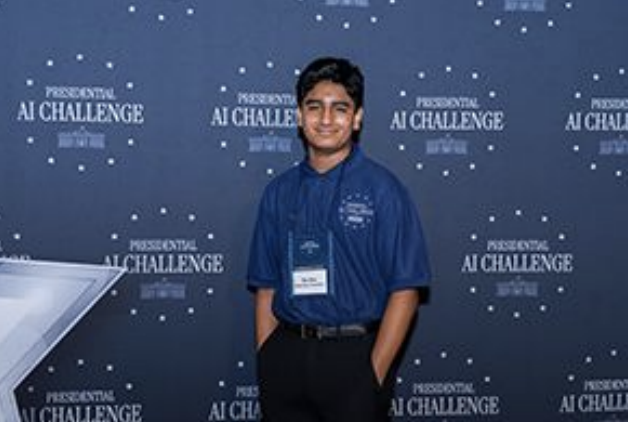
Shan Vance of Julia Landon College Preparatory School competed as a one-person team in Middle School Track 2. His project asked how accurately an AI model can detect urban blight in street-view images. Education Week described it as a tool to help cities identify blight faster.
Shan was one of more than 60 Inspirit AI students who entered in 2026. Three others won their states:
Kansas: Caden Cleveland, for Calyx, which applies constraint-based AI to healthcare staffing
Georgia: Khushii Ssharma, for NuStar, an AI-powered app to help prevent teen substance abuse
Wisconsin: George Roginsky
See more student AI projects here.
The project took first place three times: in the Florida state round, at the national finals, and in the computer science category of a regional science fair. Shan built it with mentor Abdulla Kerimov, PhD, an applied scientist at Subsurface Technology.
A few things made the project strong:
The problem is visible and local. Anyone can picture a boarded-up building or an overgrown lot.
The data already exists. Street-view images cover nearly every street, so there was no need to collect data from scratch.
The user is clear. Cities and inspectors could act on the results.
The question is measurable. Asking "how accurately" gives judges a concrete result to evaluate.
What the winning projects had in common
One specific problem. No champion tried to fix "education" or "the environment" in general. They tackled homework help, bullying, blight, investigations and navigation.
A named group of people. Each project served someone judges could picture, from classmates to city inspectors to people with visual impairments.
AI that fits the problem. Two of the six used computer vision on photos, which suited problems you can see.
Something judges can check. A working demo, a measured accuracy, or a detailed plan gives judges evidence, not just an idea.
How to plan your project before the December 23 deadline
Register now. Registration closes December 18. Line up your supervising adult first.
Pick your problem. List problems you've noticed at school or in your town. Choose one where you can name who is affected and find information or data about it.
Choose your track and AI method. Decide between Track I and Track II, read that track's scoring guide, and pick an AI approach that fits the problem.
Build or write. Spend most of your time here. Get feedback from your supervising adult or mentor every week.
Test with real people. Show your solution or proposal to the people it's meant to help, and note what they say.
Review and submit early. Score your project against the rubric, finish your write-up or demo, and submit a few days before December 23.
Common mistakes to avoid
A problem that's too broad. "AI for climate change" is hard to judge. "Predicting which streets in my town flood first" is not.
AI as decoration. If you can't explain how the AI works and why you chose it, judges will notice.
No evidence it helps. Feedback from real users or a measured result makes a project far more convincing.
Ignoring responsible use. Think about privacy, fairness and what happens when the AI gets something wrong.
Missing the eligibility check. Confirm citizenship or residency requirements before you count on competing for prizes.
Starting in December. With projects due December 23, a few weeks is not enough time to build, test and polish.
Where to get help
Official resources. The challenge site offers webinars, workshops, scoring guides, guiding questions, sample projects and an FAQ. You can also email AI.Challenge@science.doe.gov.
Your supervising adult. A teacher, parent or community leader can keep you on schedule and help with submission.
An outside mentor. Inspirit AI offers a Presidential AI Challenge mentorship that pairs students with AI researchers from Stanford, MIT and other universities, with no coding experience required. Applications for this season close November 1, 2026.
FAQ
Is the Presidential AI Challenge happening in 2027? Yes. It is now called the Presidential Super Intelligence (SI) Challenge, and registration closes December 18, 2026.
When is the submission deadline? Projects are due December 23, 2026.
Do I need to know how to code? No. Track I is a written proposal and needs no code.
Can I compete alone? Yes. A team can be one student. Shan Vance won a 2026 national title as a one-person team.
Can students outside the U.S. enter? Students at Department of Defense schools abroad took part in 2026. To compete for prizes, middle and high school students must be U.S. citizens, nationals or permanent residents.
What do winners get? In 2026, national champions received $10,000, cloud computing credits and a Presidential Award Certificate. The total prize pool was $1.5 million.
Who won the 2026 Presidential AI Challenge? Six student teams and several educators. The student champions are listed above.
What is the Seal of SI Readiness? A new 2027 award for schools that complete and document a set of milestones showing they are preparing students and teachers to use AI responsibly. From the mentors behind a 2026 national champion.
